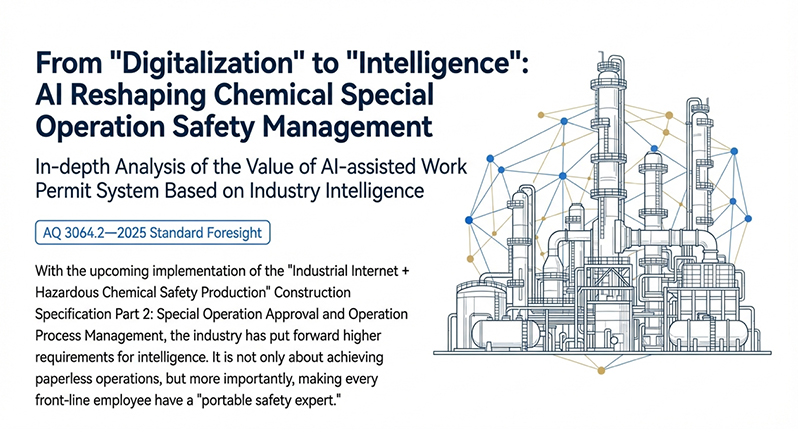

With the upcoming implementation of the “Construction Specifications for ‘Industrial Internet + Hazardous Chemical Safety Production’ – Part 2: Approval and Process Management of Special Operations” (AQ3064.2-2025), the chemical industry’s demand for intelligent safety production has entered a new phase. In-Road, deeply rooted in the field of chemical digitalization, has innovatively launched an AI-assisted work permit system, integrating artificial intelligence deeply into the full-lifecycle management of special operations. This achieves a leapfrog upgrade from “digitalization” to “digital intelligence,” injecting new intelligent momentum into the industry’s safety management.
Traditional safety management of special operations in the chemical industry relies on “logical locks” built on rigid rules such as GB30871, facing pain points including insufficient handling of flexible requirements, incomplete hidden danger identification, and prominent formalism. The “smart lock” created by In-Road’s AI-assisted work permit system, through AI context understanding technology, embeds intelligent analysis deeply into the entire process of application, assessment, approval, supervision, and acceptance. It transforms “post-event spot checks” into “full-sample real-time inspections,” fundamentally solving the industry’s long-standing problem of “having certificates but lacking capabilities and having forms but no substance.”
In the risk identification phase, the AI system demonstrates acute insight beyond manual capabilities. Taking the Level 1 hot work in the first phase of the gasification process as an example, the system can accurately capture the complex risk combination of “nighttime + low temperature + grinding + coal powder,” automatically identify the characteristics of flammable and explosive gases such as H₂ and CO and generate targeted protective suggestions by integrating hidden risks like reduced equipment tightness under low temperature and poor visibility at night. Meanwhile, the system realizes the “real-time activation” of regulations and accident cases, proactively pushing relevant clauses of GB30871-2022 and warnings of similar accidents, ensuring operators fully grasp safety bases before operations.
In the assessment and error correction phase, the AI system establishes a multi-layered logical verification mechanism, not only checking whether safety measures “exist” but also accurately judging whether they are “correct.” For scenarios where only a single combustible gas detector is used on-site, the system automatically identifies that CO is both combustible and toxic, mandating the replacement of a 4-in-1 gas detector. Through intelligent comparison, it detects detailed issues such as incorrect entry of supervisor certificate numbers and missing attachments of blind plate location diagrams, ensuring no logical loopholes in safety management.
The safety disclosure link breaks the traditional “template-based” model and generates “customized” instructions based on specific operation scenarios. For nighttime hot work grinding operations, the system formulates exclusive disclosure content from dimensions such as tool use, electrical safety, lighting guarantee, and gas monitoring, clarifying key requirements including the installation of grinding machine shields, explosion-proof lighting standards, and continuous gas monitoring, allowing safety requirements to directly reach the core of operations.
The system is also equipped with an “Eagle Eye Audit” function, conducting dual diagnosis of efficiency and compliance for the entire operation process. By monitoring key indicators such as approval time, disclosure duration, and closed-loop confirmation, it promptly warns of process bottlenecks and formalistic disclosures, promoting continuous optimization of operation management.
The launch of In-Road’s AI-assisted work permit system marks a transformative breakthrough in the safety management of special chemical operations from “human-dependent prevention” to “technology-driven prevention.” In the future, In-Road will continue to deepen the integrated application of AI technology and chemical digitalization, making “user-friendly chemical digitalization” more intelligent. It will help enterprises strengthen the line of defense for safe production and move towards a new height of intrinsic safety.