
The number of contractors in the chemical industry is surging, making high labor costs and inefficiencies in management increasingly prominent. Leveraging AI to empower contractor management, enhancing precision, reducing costs, and improving efficiency is now opportune. This upgrade of the contractor management system focuses on the core challenges within the chemical sector, with a deep optimization centered on two key functions: intelligent certificate upload and recognition, and automated subjective question grading.
I. Intelligent Qualification Certificate Recognition
1. The “Triple Challenge” of Qualification Management
Efficiency Bottleneck: Uploading a single personnel certificate takes 2-5 minutes. Calculating based on three certificates per person, data entry for one individual requires 6-15 minutes. This time consumption becomes particularly acute during major turnarounds due to the surge in personnel involved.
Error Prone: Issues such as incorrect entries for operation items and mismatched certificate validity periods are common. Manual recognition often leads to critical information like validity dates and qualification levels being overlooked.
Management Difficulty: Storing paper certificates occupies physical storage space, and retrieving a single certificate takes dozens of minutes. Validity period alerts rely entirely on manual marking.
2. From “Manual Entry” to “Second-Level Recognition”
Comprehensive Automatic Recognition: Supports recognition of over 20 types of qualification certificates. Accurately extracts six key fields including certificate name, operation item, validity period, and review date, achieving a recognition accuracy rate of over 99%.
Cross-Database Real-Time Verification: Supports automatic correlation of data across multiple systems. Completes certificate information extraction and recording with one click, while intelligently identifying and flagging anomalies such as “operation item mismatch” or “personnel name mismatch,” significantly reducing manual verification errors.
3. Results Display
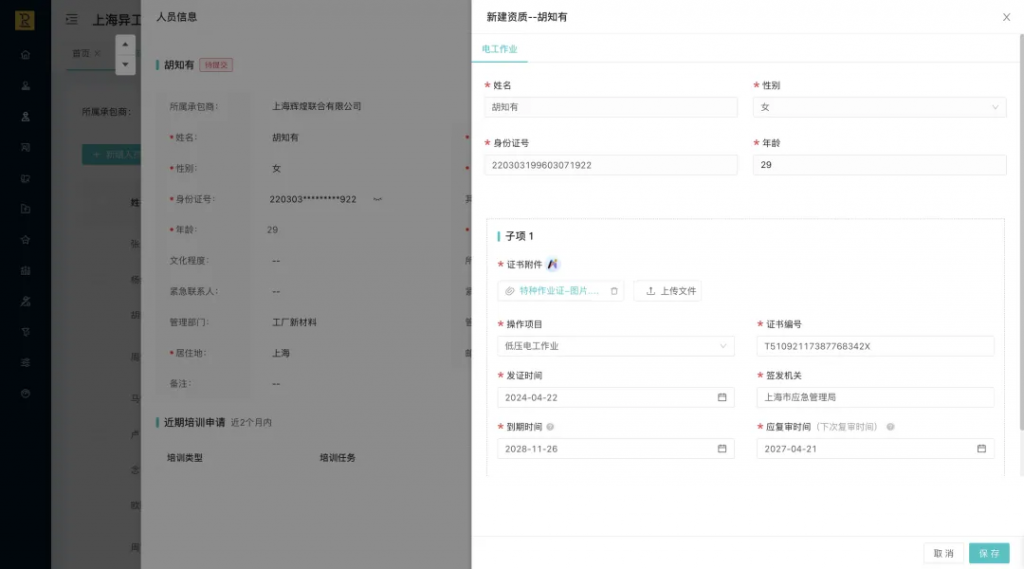
Recognition successful
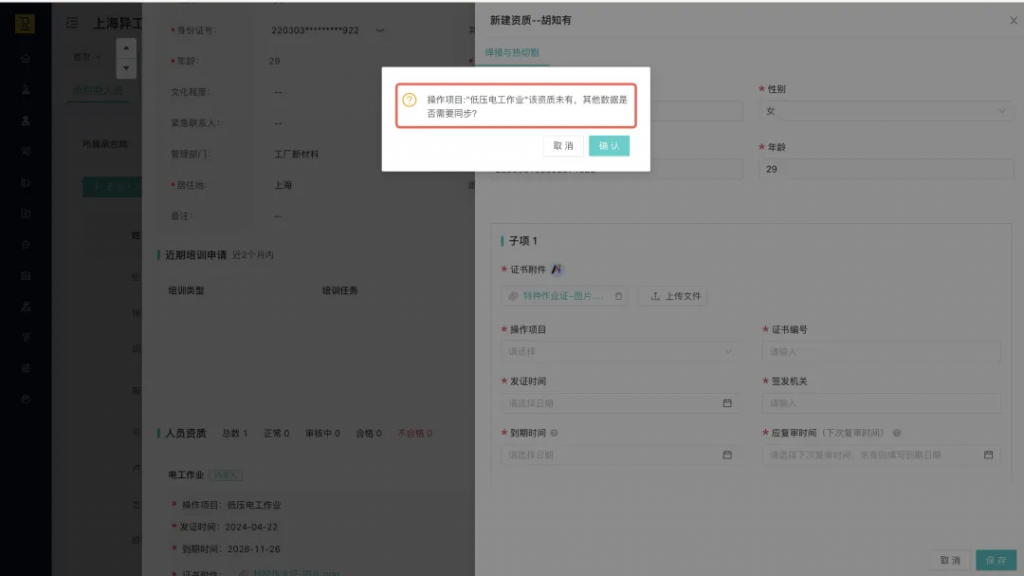
Operation item mismatch reminder
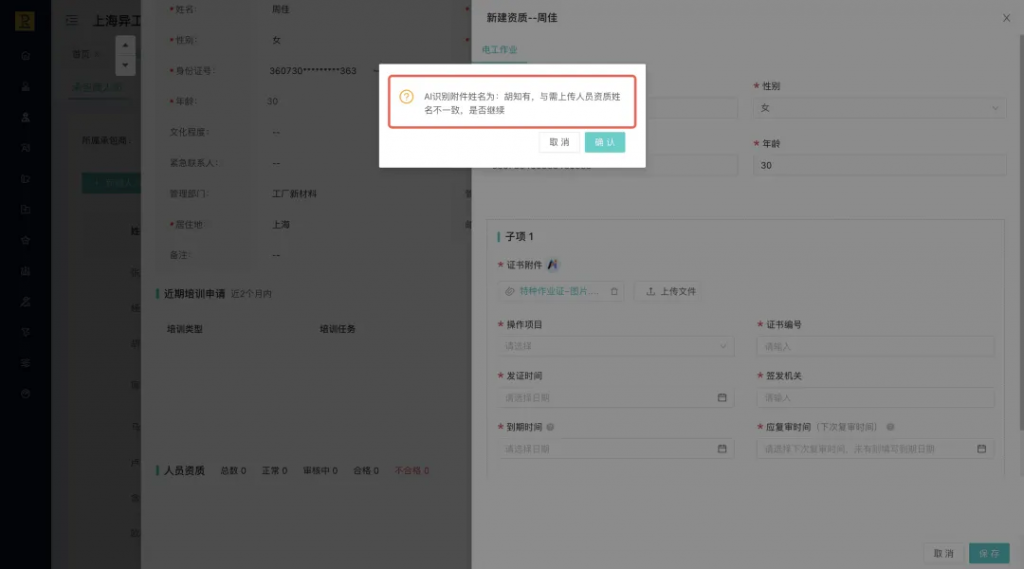
Reminder for personnel name mismatch
II. Automated Subjective Question Grading
1. The “Two Major Pain Points” of Grading Subjective Questions
Low Efficiency: Grading subjective questions in contractor technical competency tests takes an average of 15 minutes per test paper. Scoring a batch of 100 people requires 25 hours.
Inconsistent Standards: Previously, with manual grading, score discrepancies for the same subjective question between different experts could reach 20%, leading to frequent employee complaints and compromising the fairness of the assessment. Traditional manual grading is not only inefficient but also struggles to establish unified scoring criteria.
2. From “Subjective Judgment” to “Standardized & Traceable”
Reduced Score Variance: Constructs a quantitative scoring model by breaking down key answer dimensions and matching them with point values. The system automatically extracts keywords, logic, and scoring points for comparison, mitigating subjective human bias. Supports pushing results for expert review, further reducing deviation rates.
High Grading Efficiency: The system responds in seconds, reducing the time to grade a single subjective test to within 30 seconds. The time required for a 100-person assessment drops from 25 hours to 1 hour. The entire scoring process is automated, with results generated automatically, eliminating manual statistical workload.
3. Results Display
III. AI Implementation in Chemicals: Digital Intelligence Empowering Industrial Efficiency
The application of AI in the chemical industry is never about pursuing “high-end” technological gimmicks. It must be grounded in real-world operations, solving practical “day-to-day” issues like qualification audits and routine training management. The two major functional upgrades to this contractor system are precisely centered on the specific needs of chemical scenarios, allowing AI to truly take root and deliver tangible results. In the future, the system will undergo continuous iterative optimization, delving deeper into more contractor management scenarios within the chemical sector, empowering enterprises to strengthen their safety defenses and enhance management efficiency through intelligent solutions.