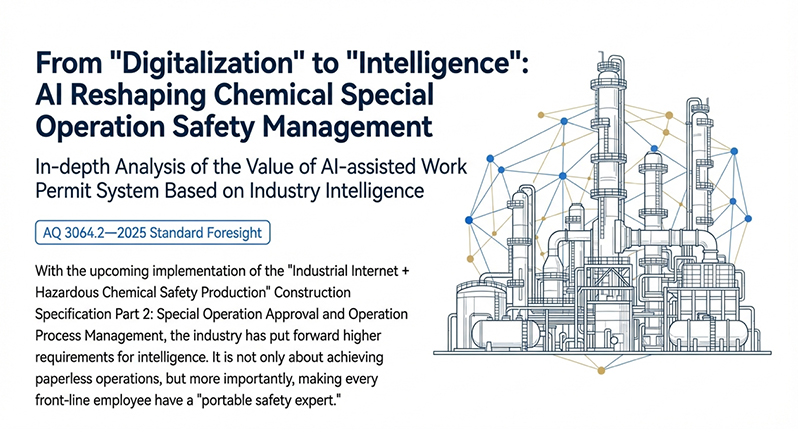

Special operations in hazardous chemical enterprises—such as hot work, confined space entry, work at height, temporary
electricity use, and blind plate drawing and plugging—are both critical links in safety risk prevention and high-risk
areas where accidents frequently occur. According to statistics from the Ministry of Emergency Management, over 40% of
chemical production safety accidents happen during special operations. In 2024 alone, there were more than 3.57 million
hot work operations and approximately 670,000 confined space entries across chemical enterprises nationwide. Such a
massive volume of operations poses severe challenges for risk control and accident prevention.
Traditional operation supervision models rely heavily on manual efforts, which suffer from uneven professional
competence of personnel, high labor costs, and low management efficiency. These issues become especially acute in
scenarios with multiple simultaneous work sites and complex environments, where supervision gaps, missed oversight, and
loss of control are prominent, posing major safety hazards.
Against this backdrop, the In-road AI Camera Smart Operation Supervision System has been launched. Centered on
intelligent mobile deployment cameras and deeply integrating AI vision recognition with IoT technology, the system
directly addresses key pain points in operation supervision, driving a leapfrog upgrade from manual supervision (“human
defense”) to technology-enabled supervision (“technical defense”). It replaces traditional human oversight with
intelligent prevention, providing all-round protection for special operations.
I.Prominent Pain Points of Traditional Operation Supervision – The Old Model Falls Short
The complex environments and dense risk points of hazardous chemical special operations make the many shortcomings of
traditional manual supervision a “weak link” in safety management. These shortcomings not only significantly increase
enterprise management costs but also create hidden dangers that are difficult to avoid.
Pain Point 1 – High labor costs, low supervision efficiency
Traditional supervision follows a “one person, one point” dedicated attendance model, where a single supervisor can only
manage one work site. When multiple special operation points are carried out simultaneously, enterprises need to deploy
a large number of supervisors, leading to persistently high labor costs. During major plant turnarounds, the number of
operation points surges, causing a pronounced shortage of supervisors. Some enterprises even resort to irregular
practices such as “one person covering multiple posts, resulting in supervision gaps”, making it impossible to achieve
comprehensive, round-the-clock effective supervision and leaving safety vulnerabilities hard to prevent.
Pain Point 2 – Lack of focused control, low precision
Chemical work sites involve various types of special operations—confined space, hot work, work at height, etc.—each with
significantly different risk profiles. However, due to uneven professional competence, some manual supervisors are only
“present on site” but fail to effectively identify site-specific risks or violations. At the same time, controls lack
specificity, often resulting in a “one-size-fits-all” approach that fails to address the differentiated risk
requirements of different special operations, significantly reducing control precision.
Pain Point 3 – Inconsistent supervision outcomes, lagging risk prevention
Manual supervision is easily affected by human factors such as fatigue, negligence, and lack of concentration. It reacts
slowly and identifies potential risks—such as rule-breaking operations or improper use of tools and equipment—only after
a delay. Often, hidden dangers are not discovered until they escalate and risks become imminent. This makes it difficult
to achieve proactive risk prevention, fails to stop safety incidents at their source, and undermines the effectiveness
of supervision.
II.AI Smart Operation Supervision – Empowering a Breakthrough to Persistent Problems
In response to the many pain points of traditional manual supervision, the In-road AI Camera Smart Operation Supervision
System was developed. With the intelligent mobile deployment camera as the core terminal, the system is deeply tailored
to the needs of hazardous chemical special operation scenarios. It enables integration with work permits and multi-data
linkage, making operation supervision smarter, more efficient, and more precise. It truly breaks the “one person, one
point” limitation, achieving “one person managing multiple posts with precise control” and fundamentally solving
supervision challenges.
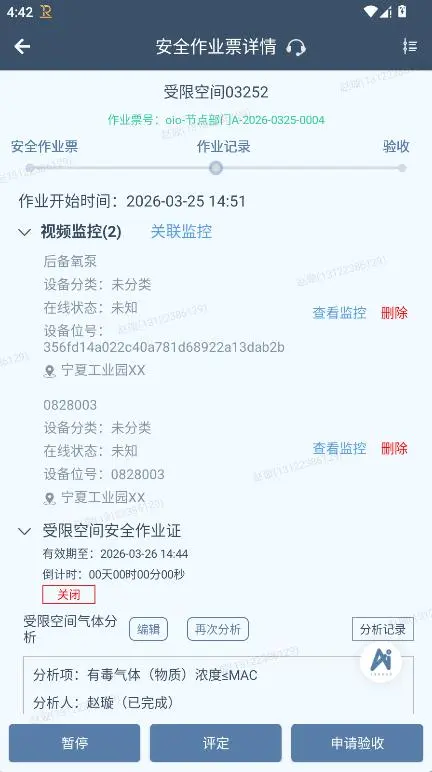
The In-road intelligent mobile deployment camera seamlessly connects with the In-road work permit system. During permit
issuance, the camera used at the operation site can be directly selected and linked, ensuring accurate binding between
permit information and real-time site data. Throughout the operation, the camera continuously records key information
such as operational video and personnel actions. After the operation is completed, the recorded data is automatically
archived, forming a complete and traceable supervision record—effectively solving the industry pain point of “data
fragmentation and supervision without evidence” while fully complying with chemical industry compliance management
requirements.
Full Functionality Coverage – Multi-dimensional Linkage for All-Round Operation Safety
1.Multi-data linkage for precise site status awareness
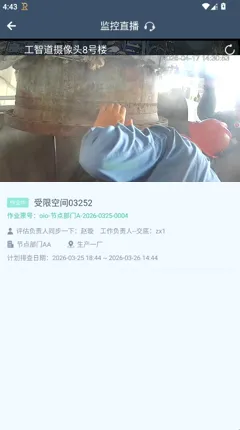
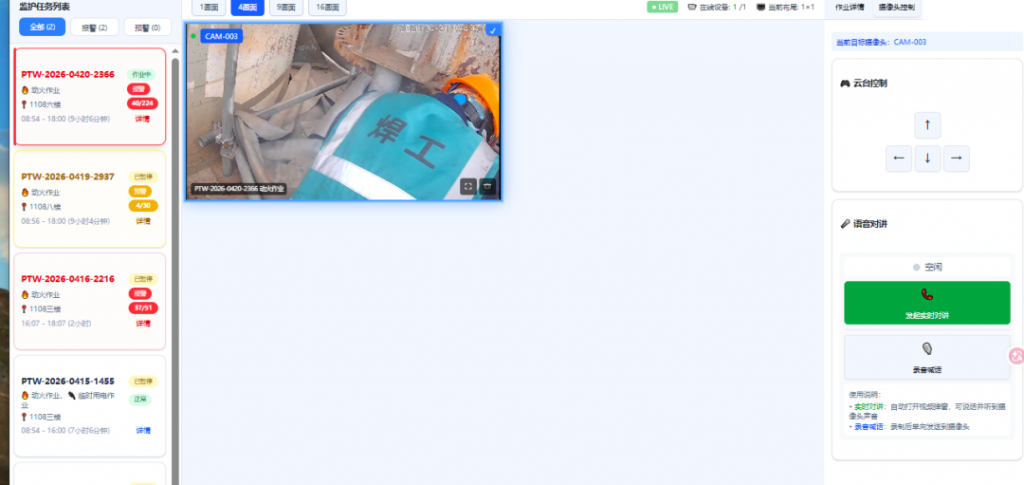
While capturing high-definition site video, the system can link multiple key data dimensions—operation content, tool and
equipment usage status, gas analysis data, personnel positioning, etc.—and synchronize them in real time to the
monitoring center. Supervisors no longer need to be physically present; they can fully and intuitively grasp the status
of the environment, personnel, equipment, and more, achieving true “remote visual supervision” and breaking spatial
constraints.
2.Remote monitoring of multiple operations – improving supervision efficiency
Leveraging an advanced human-machine collaboration framework, a single supervisor can simultaneously manage several
operation sites, completely breaking the traditional “one person, one point” limitation. This significantly reduces
enterprise labor costs for supervision while making supervision more comprehensive, response faster, and efficiency
higher.
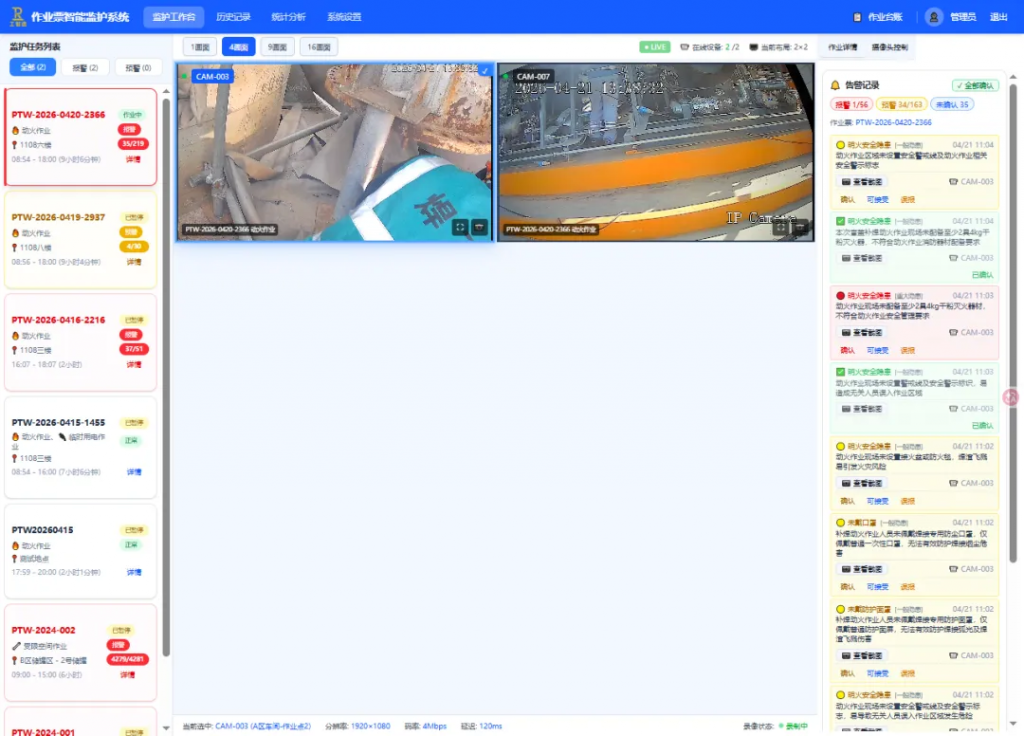
3.Violation recognition and alerts – enabling proactive risk prevention
The system incorporates high-precision AI vision recognition algorithms. It not only identifies common violations such
as workers not wearing safety helmets, but also accurately detects specific violations in specialized scenarios like hot
work and confined space entry—for example, no fire extinguisher at a hot work site, or a safety harness not tied off in
the “high-anchor, low-use” manner. Once a violation is detected, the system immediately issues an audible alert,
notifying both on-site workers and supervisors so that hazards can be quickly addressed and risks nipped in the bud.
4.Voice interaction + PTZ control – precise remote supervision
The system supports voice broadcasting and two-way intercom. Supervisors at the monitoring center can issue operational
instructions and remind of violations remotely, while on-site personnel can provide real-time feedback on progress and
site conditions, enabling “remote command and real-time coordination.” The pan-tilt-zoom (PTZ) camera can be flexibly
rotated and zoomed to capture operational details precisely, eliminating blind spots.
5.Differentiated focused supervision – tailored to each type of special operation
For different types of special operations—confined space, hot work, work at height, lifting, etc.—the system can preset
different supervision focuses, precisely matching the risk characteristics of each type. This avoids a
“one-size-fits-all” approach, achieving “one operation type, one set of standards, precise prevention.”
6.Keyword filtering – flexible adaptation to scenario needs
For certain special operation scenarios, the system supports custom-setting keywords to block corresponding alarms. Once
a keyword is blocked, the system will no longer recognize violations associated with that keyword, enabling “on-demand
supervision” that flexibly adapts to the diverse and complex site requirements of chemical enterprises.
III.Technology-Enabled Prevention – Ushering in a New Paradigm for Chemical Operation Supervision
The safety of hazardous chemical special operations is never about “watching and guarding the old-fashioned way.”
Rather, it requires intelligent technologies to solve persistent management problems, achieving dual protection through
“technical defense + intelligent prevention.” The In-road AI Camera Smart Operation Supervision System abandons flashy
technological gimmicks. Rooted in chemical enterprise work sites and focusing on real supervision pain points, it deeply
integrates AI vision recognition and IoT technologies with operation management. It not only effectively reduces
enterprise labor costs but also significantly improves the efficiency and quality of operation safety control, perfectly
aligning with the chemical industry’s core need for “safety first, prevention foremost.”
In-road will continue to deepen its focus on AI application scenarios in the chemical industry, empowering chemical
enterprise safety management with intelligent technologies, supporting high-quality and safe development of the chemical
sector, and providing replicable, scalable digital & intelligent safety solutions that fortify the defense line for
hazardous chemical special operations.